
A WIPO Form MM5 guide is an essential operational framework used by intellectual property managers and legal counsel to successfully request that the World Intellectual Property Organisation (WIPO) record a total or partial change in ownership of an international trademark registration under the Madrid System.
Managing global intellectual property assets demands absolute administrative precision. For enterprises expanding through mergers, acquisitions, or corporate restructurings, transferring rights across multiple borders via a single central mechanism is a primary operational advantage of the Madrid Protocol.
However, filing mistakes can cause major issues like costly irregularities, delayed assignments, or the loss of structural protection dates in key foreign markets. This WIPO Form MM5 guide outlines the exact statutory requirements and eligibility thresholds necessary to seamlessly transfer international trademark registrations through the WIPO International Bureau.
The Legal Framework of Madrid System Ownership Transfers
Every international trademark transfer is governed by Rule 25 of the Regulations under the Protocol Relating to the Madrid Agreement. Under this rule, a change in ownership can only be recorded if the new owner (the transferee) satisfies specific jurisdictional requirements. Unlike national assignments, which are subject to individual state laws, an international transfer requires the transferee to establish a valid entitlement within the Madrid System network.
To maintain an international registration, the transferee must possess a real and effective industrial or commercial establishment, be domiciled in, or be a national of a Madrid System member state. If the incoming owner does not meet one of these three criteria, WIPO cannot record the change in ownership. In such instances, the assignment fails at the international level, forcing parties to resort to expensive national filings or completely forfeit global coverage.
Total vs. Partial Changes in Ownership
When deploying this WIPO Form MM5 guide, legal counsel must first determine whether the transaction constitutes a total or a partial assignment. Mistaking these two pathways can cause WIPO to issue an irregularity notice, which delays processing and impacts transactional timelines.
Total Change in Ownership
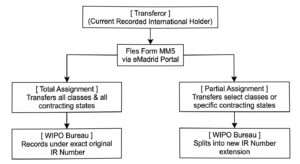
A total change in ownership occurs when the entire international registration is assigned to a single new entity. This applies across all designated contracting parties and covers all goods and services listed in the original filing. A primary administrative benefit of this method is its scalability. Practitioners can utilise a single online filing to transfer multiple international registrations from the same current holder to the same transferee.
Partial Change in Ownership
A partial change in ownership occurs when the original holder assigns only a portion of their global trademark rights. This process applies under three distinct scenarios:
- Territorial Split: Transferring all goods and services, but only for certain designated contracting parties.
- Product or Service Split: Transferring only some classes or specific items within a class for all designated countries.
- Hybrid Split: Transferring specific goods or services for only specific designated contracting parties.
When WIPO records a partial assignment, it splits the trademark. The assigned portion receives its own unique international registration number followed by a capital letter suffix. Unlike total assignments, a partial transfer request through this WIPO Form MM5 guide can only process one international registration per application.
| Transaction Attribute | Total Change in Ownership | Partial Change in Ownership |
| Asset Scope | All designated contracting parties. | Selected contracting parties only. |
| Product Scope | Every class of goods and services. | Selected items or specific classes. |
| Filing Structure | Multiple registrations allowed per form. | Strictly limited to one registration per form. |
| Resulting Numbering | Retains original IR Number. | Spawns a new IR Number with letter suffix. |
| Representative Status | Removes the transferor’s representative from the record. | Retains original rep for remaining assets. |
Critical Traps: Avoid Irregularities and Declarations of No Effect
Filing a change in ownership through the WIPO Form MM5 guide requires navigating complex cross-border regulations. Legal teams should closely monitor two primary risk areas.
Third-Party National Declarations of No Effect
Even after WIPO processes and records an assignment in Geneva, individual member countries retain local authority. Under Rule 27(4) of the Common Regulations under the Madrid Agreement and Protocol, a national office can issue a declaration that a change in ownership has no effect within its borders.”
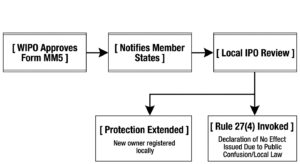
This often occurs if the assignment causes public confusion or violates national laws, such as transferring a trademark without assigning its associated business goodwill in jurisdictions where that is a statutory requirement.
The Five-Year Dependency Period Trap
New international registrations remain dependent on their underlying home application or registration (the basic mark) for exactly five years from the international registration date. If the basic mark is cancelled, refused, or restricted during this period, the international registration is also cancelled to the same extent. This vulnerability carries over to the new owner after an assignment. If a central attack dismantles the basic mark, the transferee’s assigned rights are terminated across all designated countries.
Frequently Asked Questions
Q: Do I need to submit an executed assignment deed or contract when filing a change in ownership with WIPO?
Q: Can a new owner sign and submit WIPO Form MM5 independently?
Q; What happens if the transferee fails to meet the Madrid System entitlement criteria?
WIPO will issue an irregularity notice and refuse to record the transfer, meaning the trademark ownership will remain unchanged in the International Register.
Q: How does Acnova Ltd help businesses execute international trademark transfers without legal errors?
A: Acnova Ltd. helps foreign law firms and transnational companies in China, the United States, the EU, the United Kingdom, and globally with validating transferee entitlements, optimising digital filings via eMadrid, and proactively structuring assignments to protect brands from local declarations of no effect and central dependency risks.
Q: Is Acnova Ltd. a government agency or an official branch of the WIPO?
A: No. Acnova Ltd. is a private international IP services company registered in England and Wales. It acts as an administrative filing intermediary and IP support provider.
Contact Information
- Email: contact@acnovaip.com
- Phone: +442038170250
- Global Headquarters: 71–75 Shelton Street, Covent Garden, London, WC2H 9JQ, United Kingdom