
An imprecise classification fix under the European Union Trade Mark Regulation (EUTMR) is the formal amendment process used to clarify or restrict vague goods and services descriptions. Historically, this statutory obligation was introduced under Article 28(2) EUTMR of Regulation (EC) No 207/2009 following the landmark IP Translator ruling. In the current active trademark regime governed by Regulation (EU) 2017/1001, this rule is codified under Article 33(2) EUTMR.
The transition between these legislative frameworks represents a fundamental structural shift in how European registries view applicant intent and broad economic positioning. Trademark owners and global legal practitioners frequently look for an Article 33(2) (former Article 28(2)) EUTMR remedy when caught in an unexpected office action. This process is essential to satisfying the strict statutory standards of clarity and precision required by the European Union Intellectual Property Office (EUIPO).
Understanding how to navigate this system ensures long-term portfolio health under both the active registry rules and legacy frameworks. Failing to monitor these guidelines can lead to systemic registry friction, prolonged examination loops, and unexpected financial outlays for brand managers.
The Legal Framework of EUIPO Specification
When applying for a European Union Trade Mark (EUTM), applicants must identify their sought-after goods and services with high specificity. Achieving the baseline requirement of Article 33(2) (former Article 28(2)) EUTMR clarity means that terms are clear enough to allow competent authorities and economic competitors to determine the exact scope of trademark protection. This standard protects the marketplace by ensuring third parties can easily discover existing barriers to entry.
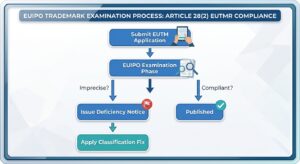
An Article 33(2) classification deficit will occur if an applicant uses descriptions that are overly broad, ambiguous, or economically incomprehensible. In these scenarios, the EUIPO examiner will halt the application process entirely. The registry then places the mark into an administrative examination loop, issuing an official deficiency notice demanding an immediate remedy from the applicant or their designated legal representative. This loop stops forward momentum and creates unwanted legal vulnerabilities.
Article 33(2) (former Article 28(2)) EUTMR Imprecise Classification Objection Triggers
The EUIPO Trademark Guidelines reject any specification that relies on open-ended language, catch-all phrases, or overly technical jargon lacking market clarity. Examiners systematically screen files to prevent businesses from unfairly monopolising entire sectors of the economy through vague drafting. This screening process ensures that monopolies are restricted only to the precise business operations an applicant actually runs.
Common triggers that breach the active standards of Article 33(2) EUTMR include:
- Open-ended terms: Phrases such as “and the like”, “including but not limited to”, or “all other goods in this class” are strictly prohibited. These strings introduce unmanageable commercial ambiguity into public search engines.
- Sweeping general expressions: Terms like “general merchandising” or “all consumer goods” lack the distinct definitions required by the registry. Examiners demand to know precisely what products cross international borders.
- Unmodified Nice Class headings: Copying an entire general class heading without specifying the actual commercial goods frequently triggers an Article 33(2) (former Article 28(2)) EUTMR classification objection if the heading contains inherently vague terms.
Furthermore, relying heavily on modern digital tech trends that lack stable industrial definitions can cause complications. For instance, drafting specifications involving decentralised ledger applications, artificial intelligence processes, or virtual asset platforms without explaining their precise end-user utility will result in a rapid objection from the classification division.
The Administrative Examination Loop and Rebuilt Deadlines
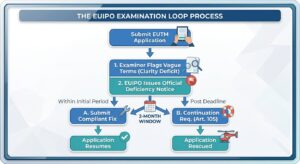
When an application fails to meet the criteria for standard clarity under Article 33(2) (former Article 28(2)) EUTMR, the EUIPO issues an official deficiency letter under Article 38(1) EUTMR in conjunction with Article 2 of the EU Trade Mark Implementing Regulation (EUTMIR). This action pauses the application and gives the applicant an initial two-month window to submit a correction.
Remaining trapped in this loop introduces severe operational liabilities for brand owners. It delays the publication of the trade mark, which extends the period during which third parties can file conflicting marks. Resolving an Article 28(2) EUTMR issue quickly prevents long-term application delays, keeping the brand’s commercial rollout strategy protected from opportunistic filings by market rivals.
While this initial two-month response period can be extended if a formal request is submitted before the window closes, failing to act ahead of time introduces severe operational liabilities. If an applicant allows the designated deadline to expire without an active extension, the EUIPO will partially or fully refuse the non-compliant terms under Article 33(4) EUTMR. This brings an abrupt end to the priority tracking of those specific terms.
To rescue a missed deadline, an applicant must formally request a Continuation of Proceedings under Article 105 EUTMR. This request must be filed through the EUIPO user area within two months of the expiry of the missed deadline and requires payment of a €400 administrative fee. If the original deadline is respected or successfully rescued, the remaining compliant terms proceed to publication, preserving the original filing priority date and preventing competitors from claiming earlier rights.
Step-by-Step Guide to Deploying an Imprecise Classification Fix
To rescue a stalled application and achieve full clarity under current Article 33(2) (former Article 28(2)) EUTMR expectations, brand managers and legal counsel must deploy an administrative fix that satisfies the examiner without compromising the commercial scope of the brand. This requires a balanced approach to textual restriction.
- Step 1: Speak to an IP agent for assistance
- Step 2: A review of the EUIPO Deficiency Letter
- Step 3: Restricting and narrowing the terms under Article 49 EUTMR
- Step 4: Utilising pre-approved terminology
Proactive Strategies: Avoiding the Loop from the Start
The most efficient way to manage application safety is to prevent objections entirely during the initial drafting phase. Avoid legacy Article 28(2) EUTMR pitfalls by bypassing custom drafting for standard business lines and relying entirely on the pre-approved dictionary entries provided by the EUIPO.
When your business model requires bespoke or highly innovative descriptions that do not exist within the Harmonised Database, you must draft your items using unambiguous language. Avoid technical engineering codes or internal company jargon; instead, use clear commercial terms that explicitly define what the product is and how it functions. Securing compliance under active guidelines protects your priority date and allows you to avoid the administrative costs of managing an office action.
Furthermore, internal corporate legal departments should establish a strict registry audit checklist prior to transmission. This baseline verification protocol acts as a defence mechanism against human error. By filtering out problematic terminology prior to the submission phase, companies can decrease the frequency of classification bottlenecks and maintain continuous, fluid asset registration tracking.
Frequently Asked Questions
Q: What happens if I miss the EUIPO deadline to fix an imprecise classification?
A: The EUIPO will officially refuse the non-compliant terms under Article 33(4) EUTMR, while the clear, compliant terms will proceed to publication under the original filing date.
Q: Can I add new goods to my application when responding to a clarity objection?
A: No. Article 49 EUTMR strictly prohibits any amendment that expands the scope of the original application, meaning your imprecise classification fix can only restrict or clarify your existing terms.
Q: Can the two-month deficiency deadline be extended?
A: Yes, provided you submit a formal request before the initial window closes. Generally, if you miss the deadline without an active extension, it immediately triggers a partial or full refusal of the vague terms under Article 33(4) EUTMR. However, you can still rescue the application by applying for a Continuation of Proceedings under Article 105 EUTMR within two months of the missed deadline, subject to an administrative fee of €400.
Q: How does Acnova Ltd. support clients facing Article 33(2) (former Article 28(2)) EUTMR Deficiencies?
A: Acnova Ltd. helps foreign law firms and transnational companies in China, the United States, the EU, the United Kingdom, and globally to successfully bypass administrative bottlenecks, execute ironclad specification amendments, and rescue stalled applications from the administrative loop.
Q: Is Acnova Ltd. a government agency or an official branch of the EUIPO?
A: No. Acnova Ltd. is a private international IP services company registered in England and Wales. It acts as an administrative filing intermediary and IP support provider.
Contact Information
- Email: contact@acnovaip.com
- Phone: +442038170250
- Global Headquarters: 71–75 Shelton Street, Covent Garden, London, WC2H 9JQ, United Kingdom