
The WIPO irregularity response deadline is a strict, non-extendable three-month period from the date the World Intellectual Property Organisation (WIPO) issues a notification under Rules 11, 12, or 13 of the Madrid Protocol Regulations. Within this window, an applicant must remedy identified formal defects or fee deficiencies to prevent the abandonment, deletion, or date-postponement of an international trademark application.
When managing cross-border intellectual property, missing this specific administrative window can unravel months of strategic preparation. This guide provides a definitive framework for corporate counsel, brand managers, and global entrepreneurs to navigate formal notices under the WIPO Madrid System.
Understanding the precise mechanics of the WIPO irregularity response deadline allows legal and brand teams to establish clear risk-mitigation safeguards. Whether your enterprise faces classification adjustments, representation errors, or fee discrepancies, resolving these issues quickly keeps your international portfolio intact. Below is a breakdown of the formal structure of these notices, the exact statutory timelines, and a step-by-step resolution path.
The Anatomy of a WIPO Irregularity Notice
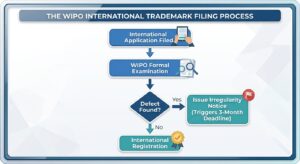
When an international trademark application is filed, WIPO conducts a rigorous formal examination. Unlike national offices (such as the UKIPO or EUIPO), WIPO does not analyse relative grounds for refusal such as prior conflicting marks. Instead, the International Bureau ensures compliance with the strict procedural criteria set out in the WIPO Madrid System Guide.
If an application fails to meet these formal benchmarks, WIPO issues an official notice of irregularity. This document clearly details the procedural errors discovered while simultaneously triggering the official WIPO irregularity response deadline. Understanding the core nature of the deficiency determines who must file the response and what corrective actions are required.
Classification of Deficiencies under the Madrid Regulations
WIPO categorises application errors into three distinct areas. The statutory framework separates the errors that can be remedied directly by the applicant from those that require intervention by the Office of Origin.
1. Irregularities with Respect to the Classification of Goods and Services (Rule 12)
WIPO evaluates whether the listed goods and services align precisely with the international standard of the Nice Classification system. If an item is incorrectly classed, the International Bureau proposes a reclassification. If the proposed changes alter the scope of the application, supplementary fees may apply.
2. Irregularities with Respect to the Indication of Goods and Services (Rule 13)
Rule 13 handles terms that WIPO considers incomprehensible, overly broad, or linguistically ambiguous. While Rule 12 focuses on the correct numerical class, Rule 13 looks at linguistic clarity and specific phrasing.
3. General Formal Irregularities (Rule 11)
This category covers administrative omissions. Common examples include:
- Failing to provide a mandatory working language translation (English, French, or Spanish)
- Submitting an unclear digital reproduction of the mark
- Leaving out required applicant contact information
- Fee deficiencies and unauthorised representative appointments under Rule 3
Managing the WIPO Irregularity Response Deadline
Calculating and monitoring the WIPO irregularity response deadline is critical. Under Rules 11, 12, and 13, the standard timeline is exactly three months from the date on which the International Bureau sends the notification.
While this deadline is structurally fixed, an exception exists under Rule 5 of the Regulations under the Madrid Protocol, which allows for an excuse for delay due to force majeure events such as natural disasters, war, or severe communication network blackouts.
Barring such extreme exemptions, failing to act within the WIPO irregularity response deadline triggers automatic legal penalties. Depending on the specific defect, your application faces total or partial abandonment, deletion of specific goods, or a postponement of the original filing date.
| Irregularity Type | Governing Rule | Who Must Respond? | Consequence of Default |
| Classification Errors | Rule 12 | Office of Origin / Applicant via Office | WIPO registers the mark with its own proposed classification. If reclassification fees remain unpaid, the application is abandoned. |
| Incomprehensible Terms | Rule 13 | Office of Origin / Applicant via Office | WIPO deletes the affected terms entirely from the application. |
| General Form Defects | Rule 11 | Direct Applicant or Office of Origin | The application is abandoned (Rule 11(4)) or the international registration date is postponed (Rule 11(2)). |
| Fee Deficiencies | Rule 11(3) | Direct Applicant or Office of Origin | The application is considered abandoned and cancelled by WIPO. |
Step-by-Step Resolution Process
To resolve an issue before the WIPO irregularity response deadline passes, your internal legal team or external IP counsel should follow this sequential workflow before filing can be done:
- Speaking to an IP agent for assistance
- Verifying the transmission date
- Determining the filing pathway
- Drafting amending submissions
- Settling any outstanding fees
The Last Resort: Requesting Continued Processing
If an enterprise misses the WIPO irregularity response deadline due to an administrative oversight, the Madrid Protocol offers a single safety net: a formal request for Continued Processing under Rule 5bis.
- The Mechanism: This petition must be submitted using official Form MM20.
- The Timeline: It must be filed within two months from the expiry date of the missed WIPO irregularity response deadline.
- The Cost: The request requires payment of the prescribed fees.
- Procedural Routing: It applies strictly to specified time limits. This includes rectifying general formal irregularities under Rule 11(2) and paying required fees resulting from classification proposals under Rule 12(7).
- Strict Limitations: Rule 5bis does NOT apply to amending the linguistic phrasing of goods and services under Rule 13. Furthermore, if a filing fee deficiency under Rule 11(3) is severe enough to cause the application to completely miss key data elements required for an international registration date under Rule 15, Continued Processing cannot retroactively salvage that original date.
- Office Routing: Formatting and routing pathways remain rigid; if the underlying remedy requires submission through the Office of Origin, the Continued Processing request and corresponding correction must still be funnelled through that specific Office of Origin to safely bypass the expired deadline.
Frequently Asked Questions
Q: Can the three-month WIPO irregularity response deadline be extended?
A: No, the three-month WIPO irregularity response deadline is fixed and non-extendable under the Madrid System Regulations. The only exception is if a formal excuse for a delay is accepted under the strict force majeure conditions of Rule 5.
Q: What happens if I fail to pay the required fees within the WIPO irregularity response deadline?
A: WIPO will declare the international application abandoned. While a request for Continued Processing under Rule 5bis can sometimes be filed within the subsequent two months, if essential initial filing elements were missing, it cannot retroactively fix a lost international registration date.
Q: Which specific WIPO irregularity deadlines qualify for a Continued Processing safety net?
A: Under Rule 5bis, Continued Processing is available if you miss the deadlines for rectifying general formal defects (Rule 11(2)) and paying reclassification fees requested by WIPO (Rule 12(7)). It cannot be used to rescue missed deadlines for amending linguistic phrasing under Rule 13.
Q: What is the difference between a WIPO irregularity and a national provisional refusal?
A: A WIPO irregularity addresses formal, classification, and procedural application defects identified by the International Bureau prior to registration. A national provisional refusal, on the other hand, is issued by a specific country after international registration and based entirely on substantive local trademark laws or prior conflicting rights.
How does Acnova Ltd assist brand owners with the WIPO irregularity response deadline?
A: Acnova Ltd. provides comprehensive monitoring, case review, and electronic filing services to foreign law firms and transnational companies in China, the United States, the EU, the United Kingdom, and globally to resolve classification and fee defects before the WIPO irregularity response deadline expires.
Q: Is Acnova Ltd. a government agency or an official branch of the UKIPO?
A: No. Acnova Ltd. is a private international IP services company registered in England and Wales. It acts as an administrative filing intermediary and IP support provider.
Contact Information
- Email: contact@acnovaip.com
- Phone: +442038170250
- Global Headquarters: 71–75 Shelton Street, Covent Garden, London, WC2H 9JQ, United Kingdom